Crypto Payment Gateway Guide for Merchants
Learn how a crypto payment gateway coordinates checkout, quotes, wallet instructions, confirmation policies, settlement, refunds, and accounting records.
Open the guideAltcoinPayments.com maps the systems behind cryptocurrency checkout—from quotes and wallet instructions to confirmations, stablecoin settlement, refunds, APIs, compliance, and reconciliation.
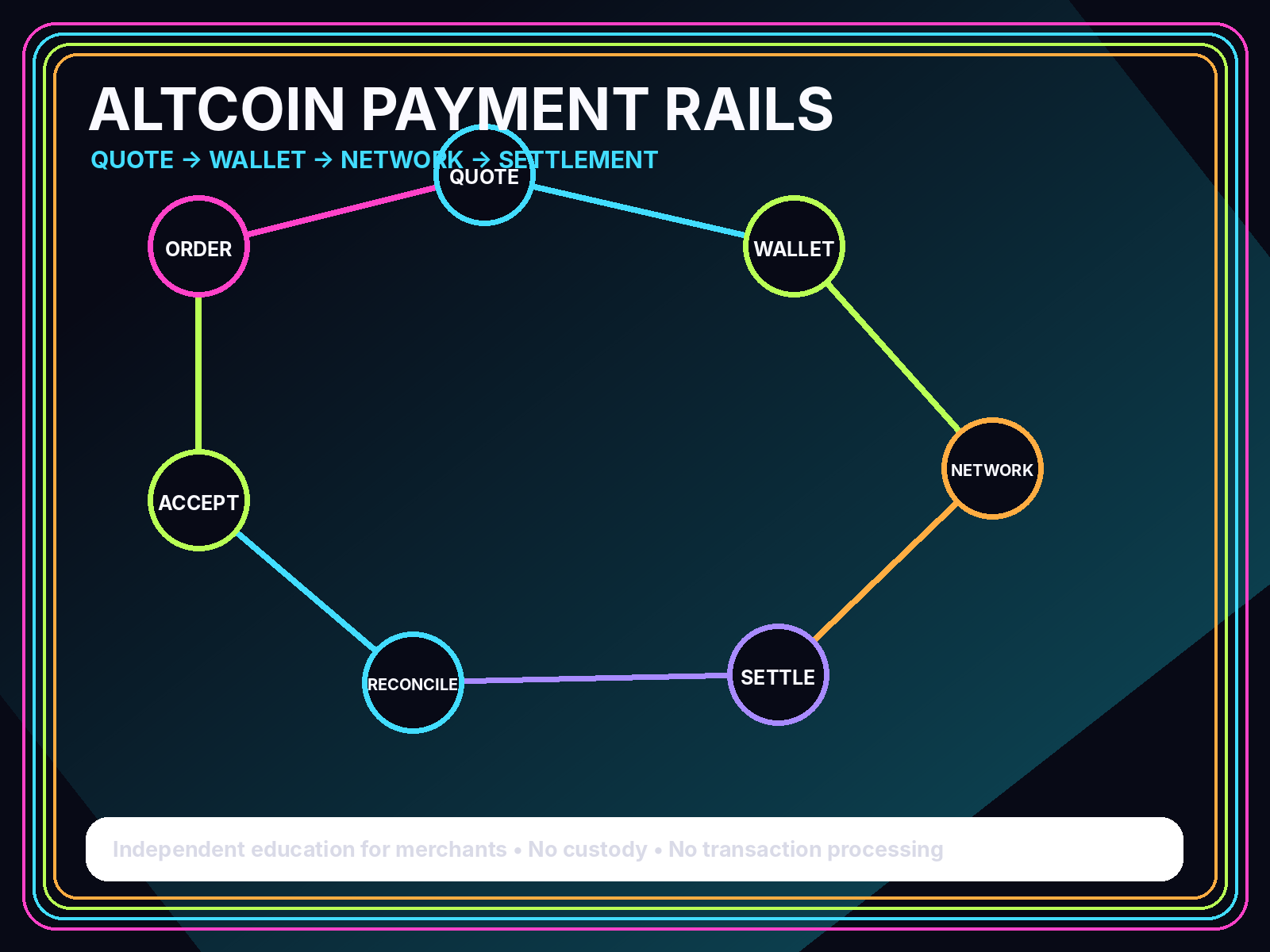
Each core guide isolates a distinct decision so product, finance, security, support, and treasury teams can work from the same model.
Learn how a crypto payment gateway coordinates checkout, quotes, wallet instructions, confirmation policies, settlement, refunds, and accounting records.
Open the guideA merchant-focused guide to USDC and other stablecoin payments, including network selection, contract verification, settlement, reserves, and operational controls.
Open the guidePlan merchant crypto payments around checkout, fulfillment, refunds, support, settlement, reconciliation, and risk controls rather than token count.
Open the guideDesign B2B crypto invoices with clear denomination, payment instructions, expiration, remittance data, settlement records, and exception handling.
Open the guidePlan a crypto payment API with idempotent orders, signed webhooks, explicit states, asset registries, reconciliation endpoints, and least-privilege security.
Open the guideEvaluate cross-border crypto and stablecoin payments through the full chain of payer access, compliance, transfer, conversion, settlement, and reconciliation.
Open the guideA dependable implementation records every transition from commercial order to reconciled settlement.
The useful comparison is not token count. It is the complete set of responsibilities, dependencies, and exception paths a merchant must operate.
| Model | Useful when | Merchant must still define | Watch closely |
|---|---|---|---|
| Managed gateway | A provider coordinates checkout, monitoring, and optional conversion. | Acceptance policy, fulfillment, refunds, reporting, and provider oversight. | Custody model, fees, webhook integrity, settlement dependencies. |
| Direct wallet rail | The business wants control of receiving infrastructure and treasury. | Address management, observation, security, reconciliation, and support. | Key management, missed events, wrong assets, operational staffing. |
| Stablecoin checkout | Invoice value should track a familiar currency unit. | Issuer, token contract, network, conversion, and balance limits. | Depegs, contract actions, wrong-network sends, liquidity. |
| Bitcoin or Lightning | Customers prefer native Bitcoin rails with distinct settlement behavior. | Invoice model, confirmations, liquidity, refunds, and wallet support. | Fee conditions, route failures, payment expiry, treasury policy. |
Use the article library to prepare architecture discussions, vendor diligence, launch tests, and operating procedures.

An operations-first guide to paying wages or contractor invoices with digital assets while preserving payroll, tax, and treasury controls.
Read the guide
A merchant-focused framework for separating ordinary wallet payments from protocol-dependent settlement and treasury activity.
Read the guide
A practical design guide for wallet connections, QR payments, mobile deep links, confirmation screens, and recovery paths.
Read the guideClear ownership and narrow scope usually matter more than supporting a long list of assets.
No. This site publishes independent educational material. It does not provide accounts, wallets, custody, exchange, checkout, or settlement services.
Start with a payment intent linked to a commercial order. Give quotes, transfers, refunds, and settlements their own records so exceptions do not overwrite history.
No. The specific token contract, network, wallet support, fee model, provider availability, and redemption path determine the operating rail.
Fulfillment should follow a documented acceptance policy that verifies the expected transfer and applies the merchant’s amount, confirmation, risk, and review rules.
Orders, onchain transfers, provider balances, conversions, fees, refunds, and bank receipts can all differ in timing. Reconciliation connects those layers and gives every difference an owner.
Use the core guides and send editorial questions, corrections, or source suggestions directly by email.